What do the latest statistics tell us about hate crime in Scotland?
In February 2026, Scottish Government published its first annual release of hate crime statistics since the Hate Crime and Public Order (Scotland) Act 2021 came into force. This shared new insights about the types of hate crimes that have occurred, the characteristics of victims and perpetrators and where in Scotland they have been reported.
The Coalition for Racial Equality and Rights (CRER) has prepared this paper to capture what these statistics tell us about racially aggravated hate crime in Scotland and provide wider context to the numbers.
The data referred to in this report can be accessed through the Scottish Government website: Hate crimes recorded by the police in Scotland, 2024-25 - gov.scot.
Hate crime in Scotland
The term ‘hate crime’ describes behaviour or actions that are both criminal AND rooted in prejudice. This includes criminal acts that have been aggravated by prejudice, malice or ill-will towards a certain group (such as racially aggravated assault or vandalism), as well as a range of specific hate offences (such as stirring up hatred or racially aggravated harassment).
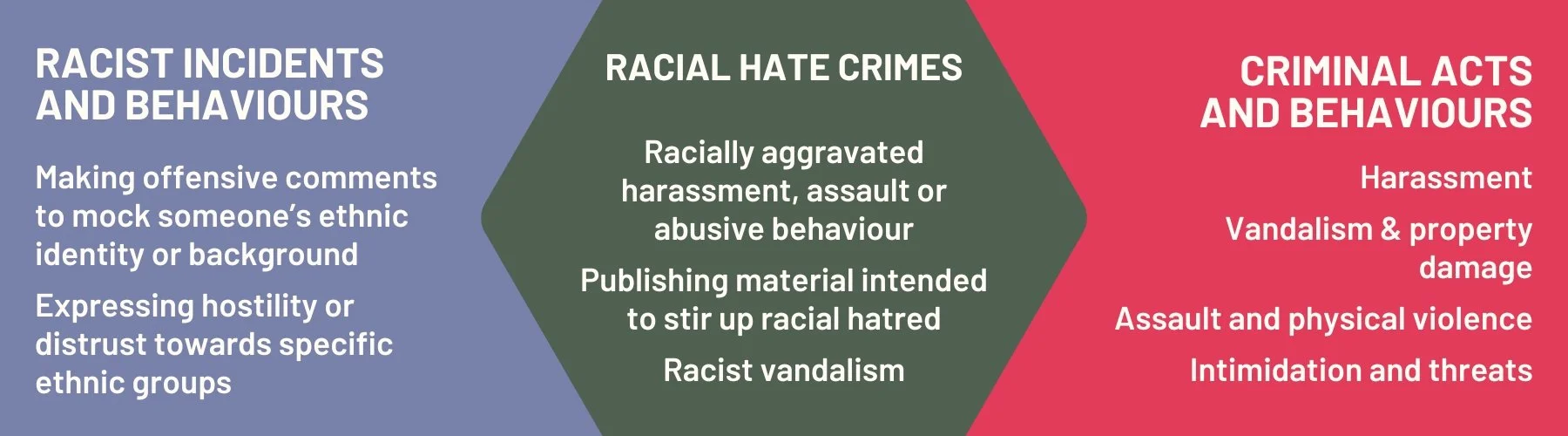
In Scotland, hate crime statistics only include crimes that have been reported to the police and formally recorded in their administrative systems. Therefore, they do not capture information about hate crimes that were not reported to the police, which is known to be a significant issue among the communities most likely to be the targets of hate crime. [1]
Hate crime in numbers
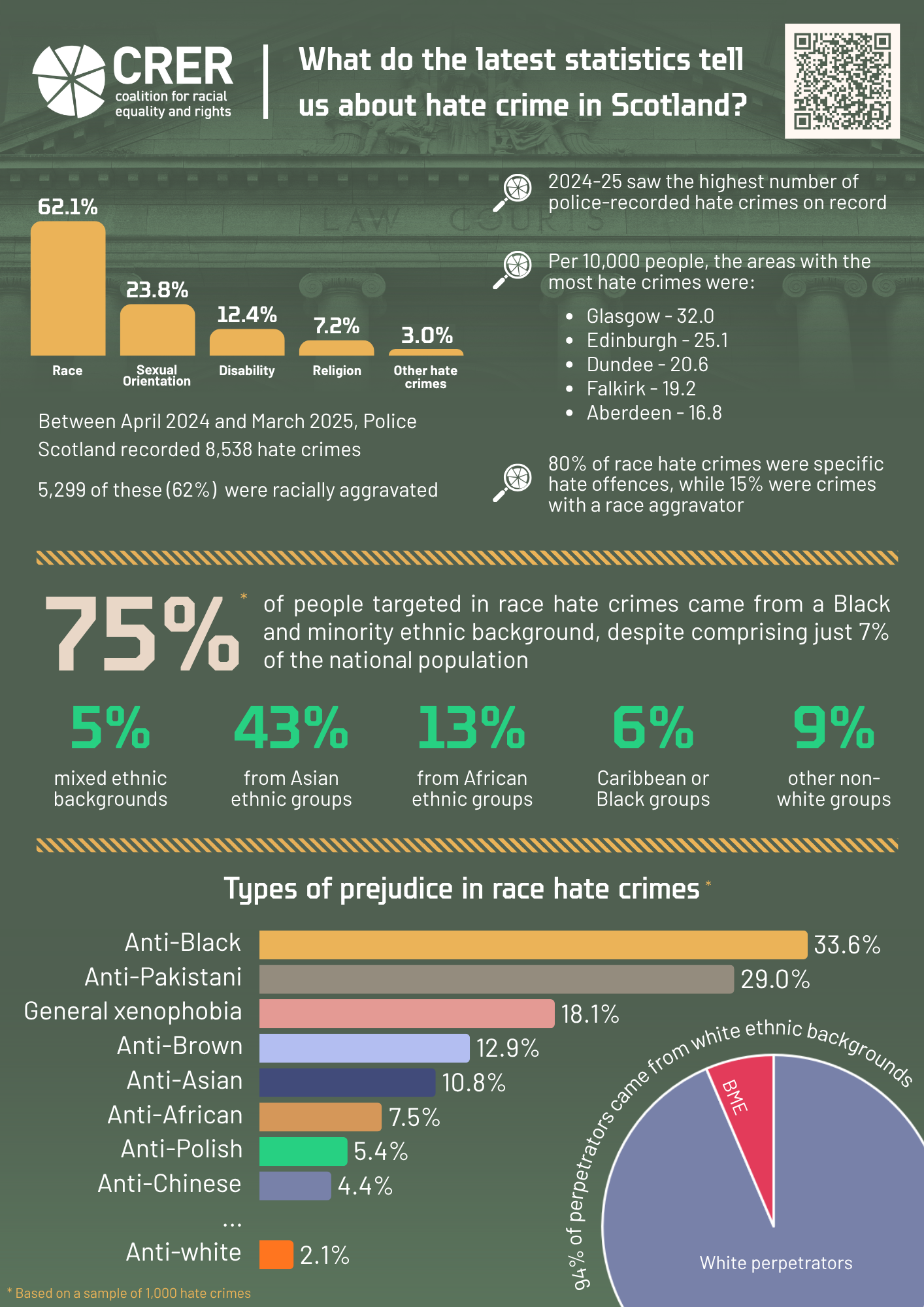
In 2024-25, the police recorded 8,538 hate crimes in Scotland. Of these, 5,299 had a race aggravator, meaning that racially aggravated incidents accounted for 62.1% of hate crimes.
The next most common aggravator was sexual orientation (23.8%), followed by disability (12.4%) and religion (7.2%). The police also recorded 635 hate crimes with multiple aggravators, constituting 7.4% of hate crimes. 177 of these hate crimes had both race and religion as aggravators.
Based on population estimates for June 2024, this means that Police Scotland recorded 15.4 hate crimes per 10,000 people in Scotland. [2] For race hate crimes, this works out to 9.6 recorded crimes per 10,000 people.
By geography
Hate crimes by local authority
These statistics can be disaggregated by local authority area, highlighting where hate crimes have occurred in Scotland. However, due to the way the data is published, our analysis covers all types of hate crime, as opposed to only crimes with a race aggravator.
Scottish Government data shows that 24% of all hate crimes in Scotland occurred in Glasgow, with a further 16% happening in the City of Edinburgh. For all other local authorities, the share of Scotland’s hate crimes did not exceed 5.1%.
Hate crimes per capita
Due to differences in geography and demography, numbers alone can struggle to reflect the prevalence of hate crimes in different parts of Scotland. Therefore, it’s often useful to consider the number of hate crimes in reference to the size of the population.
When looking at the number of hate crimes per 10,000 people, we can see that Glasgow has the highest rate of hate crime (32.0), followed by Edinburgh (25.1) and Dundee (20.5).
Racially aggravated hate crimes
Types of hate crime
In 2024-25, Police Scotland recorded 1,164 crimes with a race aggravator and 4,135 racial hate offences.
17% of race hate crimes were violent crimes - the majority of which were recorded as common assault. Offences relating to threatening, abusive and racially aggravated conduct accounted for 67% of hate crimes. Nearly one-in-ten race hate crimes were linked to online offences prosecuted under the Communications Act 2003.
Breaking this down, we see that:
For serious criminal acts with a race aggravator, common assaults were the most reported type of crime, accounting for 70% of racially aggravated crimes. This was followed by damage and reckless behaviour (21%), other violent crimes of a non-sexual nature (5%), and crimes of dishonesty (3%).
For hate offences, the most common type of hate crime was ‘threatening or abusive behaviour’, which accounted for 46% of police-recorded offences. This was followed by racially aggravated conduct (40%) and offences under the Communications Act 2003 (12%), which covers electronic communications over the internet, telephone and broadcasting.
New Act, similar story
When Scotland’s new Hate Crime and Public Order (Scotland) Act 2021 came into force, it expanded offences relating to ‘stirring up hatred’ to cover non-racial protected characteristics.
However, data from 2024-25 shows that the majority of these offences remain closely linked to race, with 75% of all ‘stirring up hatred’ offences having a race aggravator. Furthermore, even among crimes with other aggravators, such as sexual orientation, nearly 50% were still recorded as having a racial element to the crime.
Targets of race hate crime
By ethnicity
Based on a sample of 1,000 hate crimes, analysis by Scottish Government’s Justice Analytical Services found that:
75% of victims of race hate crimes came from Black and minority ethnic backgrounds
12% of victims came from white minority ethnic backgrounds, including white Irish, white Polish, and white Gypsy/Traveller ethnic groups
For reference, people from Black and minority ethnic backgrounds comprise 7.1% of Scotland’s total population, while white minority ethnic groups comprise 5.8% of the population. [3]
Looking at a greater level of detail, we can see that:
43% of victims come from Asian ethnic backgrounds (for reference, Asian ethnic groups account for 3.9% of Scotland’s population)
13% come from African backgrounds (1.1% of Scotland’s population)
6% from Caribbean or Black ethnic backgrounds (0.1% of the population)
9% from other non-white ethnic backgrounds (0.9% of the population)
5% from mixed or multiple ethnic backgrounds (1.1% of the population)
This tells us that minority ethnic groups in Scotland are much more likely to be targeted by race hate crimes than those from a majority ethnic background.
For example, despite comprising 87% of the national population, just 14% of the 1,000 hate crime sample had a white Scottish or Other white British victim. Nearly 70% of these hate crimes related to nationality-based discrimination, as opposed to skin-colour-based discrimination, which included hate crimes classified as being ‘anti-Scottish’ and ‘anti-English’.
By age
56% of victims of race hate crime are between 25 and 44 years old, with the median age of victims being 37 years old.
6.3% of victims were below the age of 16, while just 3.3% of victims were aged 60 and over.
By sex
Where race hate crimes had been reported to the police, statistics for 2024-25 show that a greater number of men were victims of racially aggravated crimes than women:
68% of victims were men, while 32% of victims were women
Further research is needed to understand the degree to which this represents gender inequalities in who is targeted by hate crime or disparities in people’s likelihood to report their experiences of hate crime to the police.
Police and non-police victims
Statistics on the number of hate crimes reported to the police show that a high proportion of victims were serving police officers and staff.
In 2024-25, 15.4% of recorded victims were police officers or police staff. 80.7% of victims did not work for the police, and 3.9% of race hate crimes did not have a specific person as a victim.
For race hate crimes with a police target, we can see that:
71.3% displayed types of prejudice specifically targeting Black and minority ethnic groups, such as anti-Black or anti-Pakistani prejudice
19% were recorded as displaying ‘general xenophobia’, meaning they were not directed at one specific group
Workforce data from Police Scotland shows that just 2% of officers and staff come from Black and minority ethnic backgrounds, meaning they are significantly over-represented as the targets of hate crime. [4] In contrast, less than 4% of police-targeted hate crimes were classified as ‘anti-white’, despite white ethnic groups comprising 98% of the police workforce.
These numbers pose some interesting questions about the representativeness of Scotland’s hate crime statistics. For instance, given that 33% of police victims were targeted with anti-Black prejudice, are a very small number of individuals having to report multiple hate crime offences against them, or are police who aren’t Black also being targeted by this type of prejudice?
Additionally, compared to the general population, to what degree are those working in the police more likely to report their experiences of hate crime? How does this skew the data we collect on hate crimes in Scotland?
Are the insights provided in Scottish Government’s statistics just the tip of the iceberg? [5]
Types of prejudice
Information is also published about the specific type of prejudice being shown in race-aggravated hate crimes, drawn from the same sample of 1,000 hate crimes analysed by Justice Analytical Services.
Data from 2024-25 shows that:
51% of race hate crimes were linked to skin colour prejudice, with 34% of incidents being linked to ‘Black’ skin colours, 13% as ‘Brown’ and 2% as ‘Mixed race’
47% were linked to nationality-based prejudice, with 29% of incidents recorded as ‘Pakistani’, 5% as ‘Polish’ and 4% as ‘Chinese’
42% were linked to general prejudice, including ‘General xenophobia’ (racial hate not directed at one specific group), prejudice targeted towards Asian, African, Middle Eastern, Jewish and Gypsy, Traveller or Roma groups, as well as hate crimes targeting refugees and asylum seekers
Comparatively, a very low proportion of race hate crimes were classified as being ‘anti-white’ or being directed towards UK nationalities. For example, just 2% of hate crimes were recorded as displaying anti-white skin colour prejudice, and less than 5% of hate crimes were recorded as displaying anti-Scottish or anti-English prejudice.
Perpetrators of hate crime
Scottish Government’s Justice Analytical Services has also provided estimates on the ethnic identities of perpetrators. They found that:
94% of the perpetrators of race hate crime were from white ethnic backgrounds
2% of perpetrators came from Asian ethnic backgrounds
Less than 2% of perpetrators came from Caribbean or Black ethnic backgrounds
Similar patterns can also be observed for other types of hate crime. For example, 99% of the perpetrators of disability hate crime came from white ethnic backgrounds, as with 97% of religion-based hate crimes and 94% of sexual orientation and transgender identity-based hate crimes. For age-based hate crimes, 91% of perpetrators came from white ethnic backgrounds.
Putting these numbers in context
Under-reporting in Scotland
Hate crimes are not always reported to the police. As a result, many will not be captured in the police-recorded hate crime data published by Scottish Government, which can skew statistical trends and present an overly positive view of hate crime in Scotland.
Evidence suggests that this is a significant issue for racially aggravated hate crimes, as the communities most likely to be targeted are often less likely to take formal action and report their experiences to the police.
For example, a 2025 study by Dr Nasar Meer and colleagues at the University of Glasgow, Strathclyde and Edinburgh Napier found that:
48% of people from Black, Asian and visible minority ethnic communities who had experienced discrimination opted not to pursue any course of action [6]
Many factors contribute to this trend, including people’s confidence in being listened to and supported by the police, their confidence in the law being upheld, and whether they believe going through the reporting process would be worth the time, effort and potential re-traumatisation. Ultimately, if someone does not believe that their complaint will lead to justice, they may be reluctant to engage with relevant authorities and report their experience of hate crime.
The prevalence of under-reporting can sometimes impact the public sector’s responsiveness to shifts in hate crime. For example, there is a common narrative where the increasing numbers of hate crimes are attributed to improved confidence in reporting mechanisms as opposed to legitimate increases in racist violence and abuse.
For example, during the June 2025 Policing Performance Committee meeting, when questioned about the rising numbers of hate crimes in Scotland, a representative from Police Scotland said:
“We have had increased awareness raising as a result of the new [hate crime] guidance and the work we’ve done through our hate crime champions […] But certainly, I would like to think that a lot of that [increase] is about increased confidence to report.” [7]
This explanation diverges from community lived experience and other sources of evidence, which tend to suggest that hate is becoming increasingly prevalent and overt in Scotland, spurred by the impact of racist and far-right influences across political discourse, social media and everyday interactions. [8]
Time and Place - how do these figures compare?
Due to differences in policy and legislation, it is not possible to directly compare these new figures to previous years or other parts of the UK; however, some comparison may still be useful for illustrative purposes.
Change over time
In 2024-25, the police recorded 5,299 hate crimes with a race aggravator.
In Scottish Government’s 2023-24 publication (which captured hate crimes recorded under Scotland’s previous legislation), the police recorded 3,907 hate crimes with a race aggravator.
Looking at the 10 years prior to Scotland’s legislative changes, an average of 4,425 racially aggravated hate crimes were recorded by the police each year – reaching a maximum of 5,178 in 2014-15.
Compared to England and Wales
Hate crimes in Scotland are governed by different laws compared to England and Wales, preventing direct comparison.
However, for reference, data published by the UK Home Office shows that, in 2024-25, 98,887 race hate crimes were recorded by the police across England and Wales. [9] This meant that 71% of hate crimes in England and Wales were recorded as having a race aggravator, compared to 62% of hate crimes in Scotland.
Adjusting this for national population size, we see that in England and Wales, the police recorded 16.0 race hate crimes per 10,000 people, while in Scotland, the equivalent figure stands at 9.6. However, as these figures are not adjusted for the demographic contexts of each nation, they do not account for the different numbers of Black and minority ethnic people living in Scotland compared to England and Wales.
Comparisons can also be drawn about the types of offences committed. While hate crimes are legislated differently, and the data is not collected or recorded in a consistent fashion, we can see that:
|
In Scotland: |
In England and Wales: |
|---|---|
|
48% of race hate crimes were recorded as public order offences |
55% of race hate crimes were recorded as public order offences |
|
20% as racially aggravated harassment or conduct |
17% as stalking and harassment |
|
15% as non-sexual crimes of violence |
15% as violence without injury |
|
10% as offences under the Communications Act 2003 |
5% as violence with injury |
What happened after hate crimes were reported?
When the police have enough evidence to support a potential prosecution, hate crimes are referred to the Crown Office and Procurator Fiscal Service (COPFS), who will evaluate each case and decide whether to prosecute, offer an alternative action or take no further action.
In 2024-25, a total of 3,357 charges relating to race hate crime were reported to COPFS. Given that Police Scotland recorded 5,299 race hate crimes in this period, this indicates that approximately 63% of race hate crimes led to formal charges being made. [10]
Data from COPFS shows that 80% of these charges led to court proceedings, while 10% were merged into broader charges and not separately prosecuted as racially aggravated hate crimes. 4% of charges were resolved through direct measures rather than court proceedings, which includes non-court actions such as fines, warnings, work orders or referral to social work or other support services.
1.5% of hate crime charges were referred to the Scottish Children’s Reporter, the body within the Children’s Hearings System responsible for interventions involving children and young people in conflict with the law.
In 2% of cases, the Crown Office and Procurator Fiscal Service decided to take no action against charges of race hate crime.
In closing
So, what can we learn from the latest statistics about hate crime in Scotland?
For one, figures from 2024-25 demonstrate that racism is not a marginal or occasional problem in Scotland. Racially aggravated hate crimes still make up the majority of recorded hate crime, and Black and minority ethnic people remain disproportionately represented among those targeted.
But the statistics can only capture part of this reality. They measure the specific incidents that have been formally recorded in the justice system, but they omit the experiences of hate that are unlikely to be reported and cannot quantify the fear and everyday harm that stems from racist hate crime.
The statistics are not just a record – they serve as a warning. They tell us that racism remains a serious and persistent threat to community safety and cohesion in Scotland.
Hate crimes do not emerge in a vacuum. When racism is normalised in our political debates, amplified online and dismissed as the behaviour of a small minority, this creates the conditions for abuse, intimidation and violence to thrive. The recent outbursts of racist violence and disorder across Glasgow, Edinburgh, Aberdeen and Scotland’s central belt serve as a stark reminder of what can happen when racist attitudes, divisive rhetoric and extremist influences go unchallenged.
While legislative progress is welcome, the strengthening of hate crime law in Scotland represents just a fraction of the work needed.
CRER believes that all groups, all communities and all sectors have a role to play. Tackling racism requires more than simply recording hate crimes once they have already happened; it requires sustained, preventative action from public bodies, policymakers, communities and individuals alike.
If you don’t challenge racism, who will?
References
[1] Meer, N. (2025). Self-Reported Discrimination in Scotland, 2015–2019. Taking Stock: Race Equality in Scotland. The Runnymede Trust.
[2] National Records Scotland (2025). Mid-2024 population estimates.
[3] Staddon Foster, L. (2024). Scotland’s Census 2022: What do the latest statistics tell us about minority ethnic groups in Scotland? Coalition for Racial Equality and Rights (CRER).
[4] Police Scotland (2025). Equality and Diversity Employment Monitoring Report – 23/24. Scottish Police Authority.
[5] Galbraith, J. (2020). New hate crime figures: the tip of the iceberg? Coalition for Racial Equality and Rights (CRER).
[6] Meer, N. (2025). UofG led survey shows that racial discrimination continues to rise in Scotland. University of Glasgow – University News.
[7] Scottish Police Authority (2025). Policing Performance Committee Meeting Livestream – 10 June 2025. Accessed on 12/06/2026.
[8] Meer, N. (2025). UofG led survey shows that racial discrimination continues to rise in Scotland. University of Glasgow – University News.
[9] Home Office (2025). Hate crime, England and Wales, year ending March 2025.
[10] Crown Office and Procurator Fiscal Service (2025). Hate crime in Scotland, 2024-25.